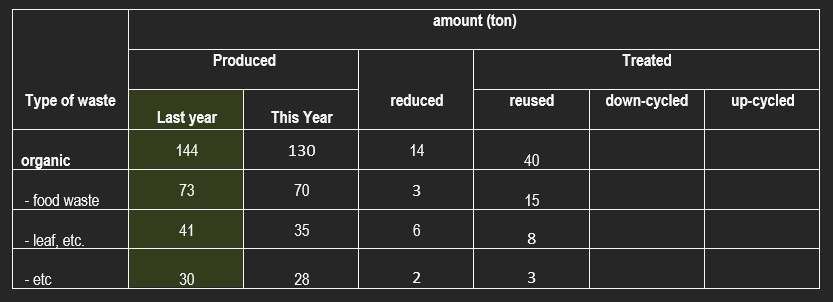
Summary Statistics
• Total organic waste generated this year: 130 tons
• Reduction compared with last year: 14 tons (9.7%)
• Organic waste reused: 40 tons (30.8% of total organic waste)
• Down-cycled: None
• Up-cycled: None
Organic waste generated at Andijan State Technical Institute mainly consists of food waste from campus cafeterias, leaves and garden residues from landscape maintenance, and other biodegradable materials. During the reporting year, the institute generated 130 tons of organic waste, representing a 9.7% reduction compared to the previous year's 144 tons.
The institute applies sustainable organic waste management practices by separating biodegradable waste at the source and reusing approximately 40 tons of organic materials. Food waste is collected for appropriate reuse where applicable, while leaves and garden residues are reused as mulch and organic compost for maintaining the campus green areas. These practices reduce the amount of waste sent to landfills, improve soil quality, and contribute to a circular resource management system.
The university continues to expand awareness campaigns on waste segregation and composting as part of its Green Campus policy, supporting SDG 12 (Responsible Consumption and Production), SDG 13 (Climate Action), and SDG 15 (Life on Land).