Organic Waste Management
Andijan State Technical Institute implements an integrated organic waste management system as part of its Green Campus and Sustainable Waste Management Policy. Organic waste generated on campus is collected, separated, and treated using environmentally friendly methods to minimize landfill disposal, recover valuable resources, and reduce environmental impacts. These initiatives support SDG 12 (Responsible Consumption and Production), SDG 13 (Climate Action), and SDG 15 (Life on Land).
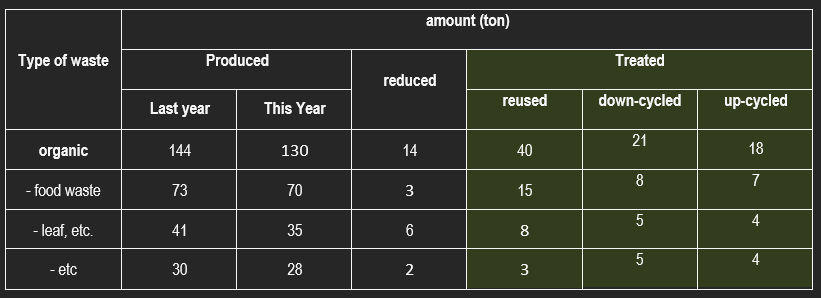
During the current reporting year, the institute generated 130 tons of organic waste, representing a reduction of 14 tons (9.7%) compared with 144 tons generated during the previous year. The organic waste stream consisted primarily of food waste from university cafeterias, leaves and grass generated through landscape maintenance, and other biodegradable materials produced from daily campus operations.
To maximize resource efficiency and promote circular resource management, the university treated organic waste through three sustainable approaches:
- Reuse (40 tons): Organic materials such as leaves, grass clippings, and suitable biodegradable waste were reused for landscape maintenance, mulching, compost preparation, and other campus horticultural activities.
- Down-cycling (21 tons): Organic waste that could not be directly reused was processed into lower-value products such as compost, soil conditioners, and biomass materials for non-food applications, reducing landfill disposal and improving resource recovery.
- Up-cycling (18 tons): Selected organic waste streams were converted into higher-value products through innovative resource recovery practices, including the production of high-quality organic fertilizer and other value-added materials where applicable.
Organic waste is separated at the source through designated collection points located in cafeterias, campus buildings, dormitories, offices, and outdoor green spaces. The institute continuously promotes waste segregation among students and staff through environmental awareness campaigns, educational workshops, and Green Campus initiatives, ensuring that biodegradable materials are properly managed before treatment.
Compost and organic soil conditioners produced from campus organic waste are applied to maintain university gardens, trees, lawns, and landscaping projects, reducing dependence on chemical fertilizers while improving soil quality and biodiversity. These practices also contribute to lowering greenhouse gas emissions associated with landfill disposal and support the institute's long-term sustainability objectives.
The university continues to strengthen its organic waste management program by improving collection systems, expanding composting capacity, encouraging sustainable consumption, and promoting innovative circular economy practices. Continuous monitoring of waste generation and treatment performance enables the institute to identify opportunities for further waste reduction and improve environmental performance each year.