Program to Reduce the Use of Paper and Plastic on Campus
Andijan State Technical Institute
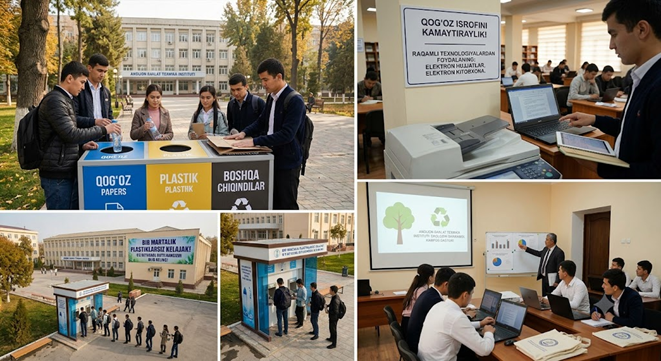
Program Overview
Andijan State Technical Institute is committed to reducing paper and plastic consumption through a comprehensive Green Campus Initiative that promotes sustainable resource management and environmentally responsible behavior among students, academic staff, and administrative personnel.
These initiatives contribute directly to the achievement of SDG 12 Responsible Consumption and Production, SDG 13 Climate Action, and SDG 15 Life on Land.
1. Digitalization and Paperless Administration
The institute has implemented digital technologies to significantly reduce paper consumption in daily operations. Administrative documents, official correspondence, meeting notices, student registration, examination processes, academic records and internal communication are managed through electronic systems.
Staff members are encouraged to use digital signatures, electronic document sharing and cloud-based storage instead of printed documents.
2. Paper Reduction Practices
To further minimize paper consumption, the institute has introduced the following measures:
- Double-sided printing as the default setting for office printers.
- Careful review of documents before printing to avoid unnecessary copies.
- Preference for electronic reports, online forms and PDF documents.
- Reuse of paper for internal drafts whenever appropriate.
- Electronic submission of assignments, laboratory reports and projects through the Learning Management System (LMS).
3. Plastic Reduction Program
The institute actively reduces single-use plastics through the following initiatives:
- Promotion of reusable water bottles, cups and food containers.
- Installation of drinking water refill stations.
- Reduction of disposable plastic bags during university events.
- Environmentally friendly packaging for campus vendors.
- Awareness campaigns addressing plastic pollution.
4. Awareness and Green Campaigns
- Green Campus Week activities.
- Student-led environmental clubs.
- Tree planting campaigns.
- Campus clean-up campaigns.
- Waste reduction seminars.
- Sustainability workshops.
- Information boards and social media campaigns promoting the 3R principles.
5. Monitoring and Continuous Improvement
The institute continuously monitors paper and plastic consumption, evaluates waste reduction performance, and encourages every department to adopt environmentally responsible practices.
Continuous improvements in digital services, sustainable procurement and waste management support the institute's long-term sustainability strategy.
198
Previous Year
Total Paper & Plastic Waste (tons)164
Current Year
Total Paper & Plastic Waste (tons)34
Tons Reduced
Total Reduction17.2%
Overall Reduction
Compared to Previous YearOverall Impact
Through these integrated sustainability initiatives, Andijan State Technical Institute successfully reduced the combined volume of paper and plastic waste from 198 tons during the previous reporting year to 164 tons during the current reporting period.
This represents an overall reduction of 34 tons (17.2%). The achievements demonstrate the effectiveness of digital transformation, responsible procurement, waste minimization, reusable materials, recycling initiatives and environmental awareness programs.
These efforts contribute to reducing waste generation, lowering greenhouse gas emissions, conserving natural resources and strengthening environmental awareness throughout the university community while supporting SDG 12, SDG 13, and SDG 15.